The Supreme Court’s judgement issued on 2 June 2026 may not read like headline news to most. It deals with deprivation of liberty safeguards, mental capacity assessments and legal frameworks.
This ruling has the potential to affect hundreds of thousands of people across England and Wales, including people with learning disabilities, autism, dementia, acquired brain injuries, and severe mental illness. Many are individuals who cannot always advocate for themselves, including those supported by National Care Group
That is why NCG believes the issue requires urgent attention from government.
Since 2014, the Cheshire West judgment has provided a clear legal test. Where a person lacks the mental capacity to consent to their care, is under continuous supervision and control, and is not free to leave, they are considered to be deprived of their liberty. This triggers safeguards including independent assessment, advocacy, and oversight; all designed to ensure care arrangements are lawful and in a person’s best interests.
The new judgment appears to reinterpret aspects of that framework. It has been understood by some as narrowing how deprivation of liberty is defined, particularly in relation to individuals with profound cognitive disabilities.
It also raises important questions about how factors such as a person’s level of awareness, their ability to express objection, and apparent compliance with care arrangements may be weighed in determining whether a deprivation of liberty is taking place.
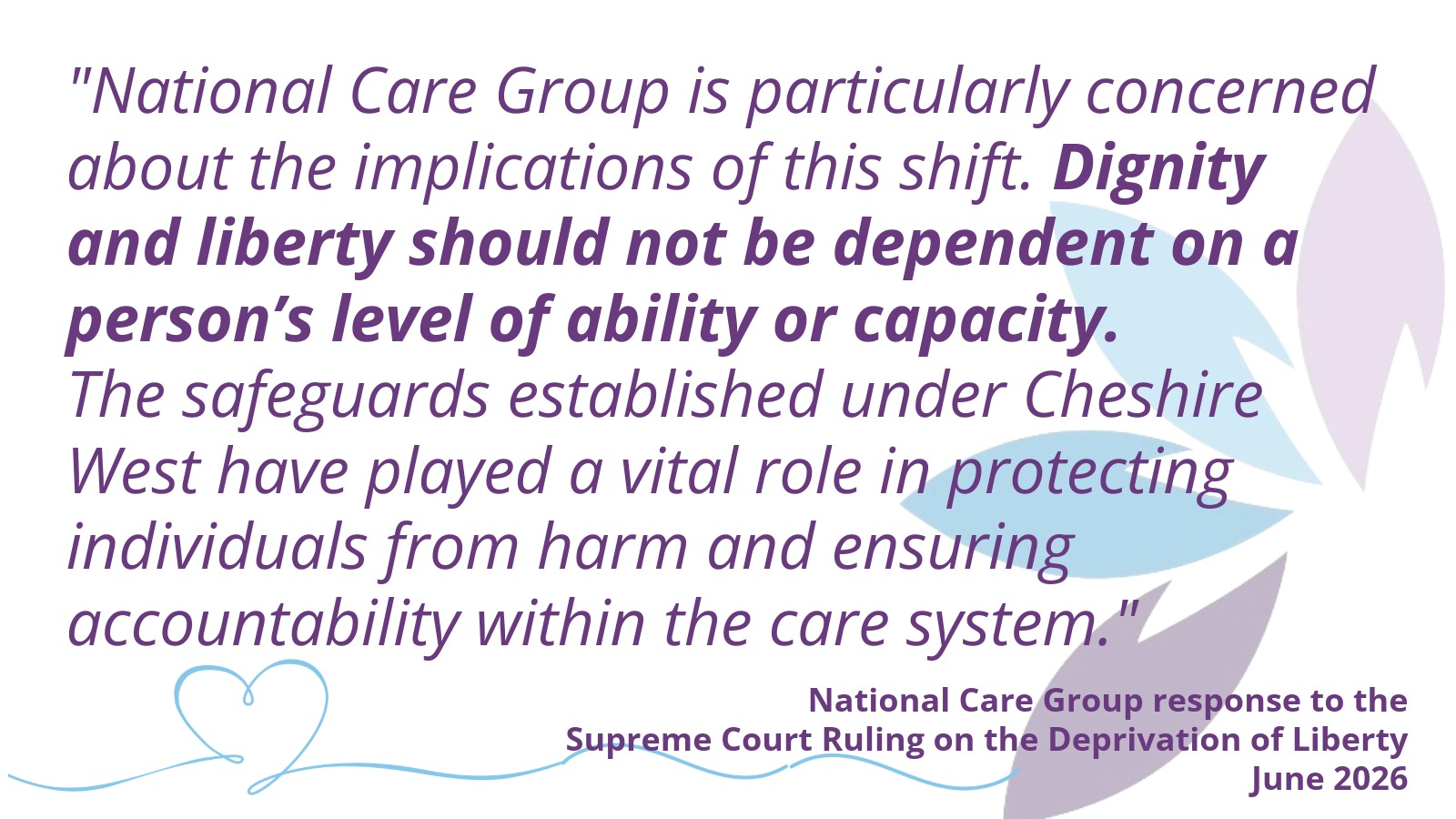
We are concerned about the implications of this shift. Dignity and liberty should not be dependent on a person’s level of ability or capacity. The safeguards established under Cheshire West have played a vital role in protecting individuals from harm and ensuring accountability within the care system.
At National Care Group, we support individuals who live in structured and supervised environments. In some cases, restrictions are placed on movement, access to the community, and aspects of daily life.
These restrictions must always be lawful, proportionate, regularly reviewed, and subject to independent scrutiny.
Under the post-2014 framework, that scrutiny was routinely engaged. Following this judgment, there is now uncertainty about when those protections will apply in practice.
Across the sector, existing Deprivation of Liberty Safeguards (DoLS) authorisations may need to be reconsidered. Families may be unclear about whether their loved ones’ rights and protections have changed. Providers, commissioners, and local authorities will likely require clear guidance on how to proceed.
We are particularly concerned about individuals who may not express objection to their circumstances, not because those circumstances are appropriate, but because their condition limits their ability to do so. A lack of objection should not be assumed to indicate consent.
National Care Group will not reduce its standards of safeguarding or oversight in response to this ruling. Where we assess that a person’s circumstances amount to a deprivation of liberty, we will continue to seek appropriate authorisation. Where we have concerns, we will act on them. While the legal framework may evolve, our commitment to protecting the people we support remains unchanged. However, providers cannot replace the role of a clear and consistent national framework. We are therefore joining others across the sector in calling for urgent action.
~ Mike Cleasby, Chief Quality & Risk Officer
We are calling on the government to:
The individuals we support did not choose the circumstances that make them vulnerable. They deserve a legal system that consistently and effectively protects their rights.
We will continue to engage constructively with policymakers, partners, and the media to ensure this issue receives the attention it requires
Read more on how NCG provides the highest standards of support to all we work with.
Registered in England, Company No. 10080257
Registered office: Suite 22, The Globe Centre, St James Square, Accrington, BB5 0RE